Showing posts with label school design. Show all posts

Friday, February 5, 2021

PLANNING LEARNING SPACES IN PRACTICE LAUNCHED

 Super stoked to see https://planninglearningspaces.com/planning-learning-spaces-in-practice/ launched which show cases the #planninglearningspaces case study at Grey Lynn School, Auckland which I was proud to facilitate.

Over the last year I have been working with Terry White, who is the UK Project Director of Planning Learning Spaces. I spent my time in lock down in New Zealand doing research and development around co-creating a series of workshops that could be facilitated to support the PLS Design Framework.


These workshops were  facilitated as a trial to develop a prototype in two Auckland New Zealand Schools: Grey Lynn Primary and Oranga Primary in Auckland and in Trumpington Park School in Cambridge.

Having completed the PLS framework through my role as a Professional Learning Facilitator I am now able to  implement the professional learning needs identified in the "Project Implementation Review" workshop in these two schools.

Teaching teams are now building on the PLS framework and digging deeper to develop collaborative practices in their learning hubs through my work as a Ministry of Education Professional Learning Facilitator with Momentum Learning.

In New Zealand the next round of MOE PLD funding applications closes on 19 February, 2020. I am happy to speak or facilitate workshops online around my areas of expertise.

Both streams are exciting work and anyone interested in exploring futher can contact me if you wish to explore options. sjconsultnz@outlook.com

Tuesday, February 5, 2019

Learner Led Design

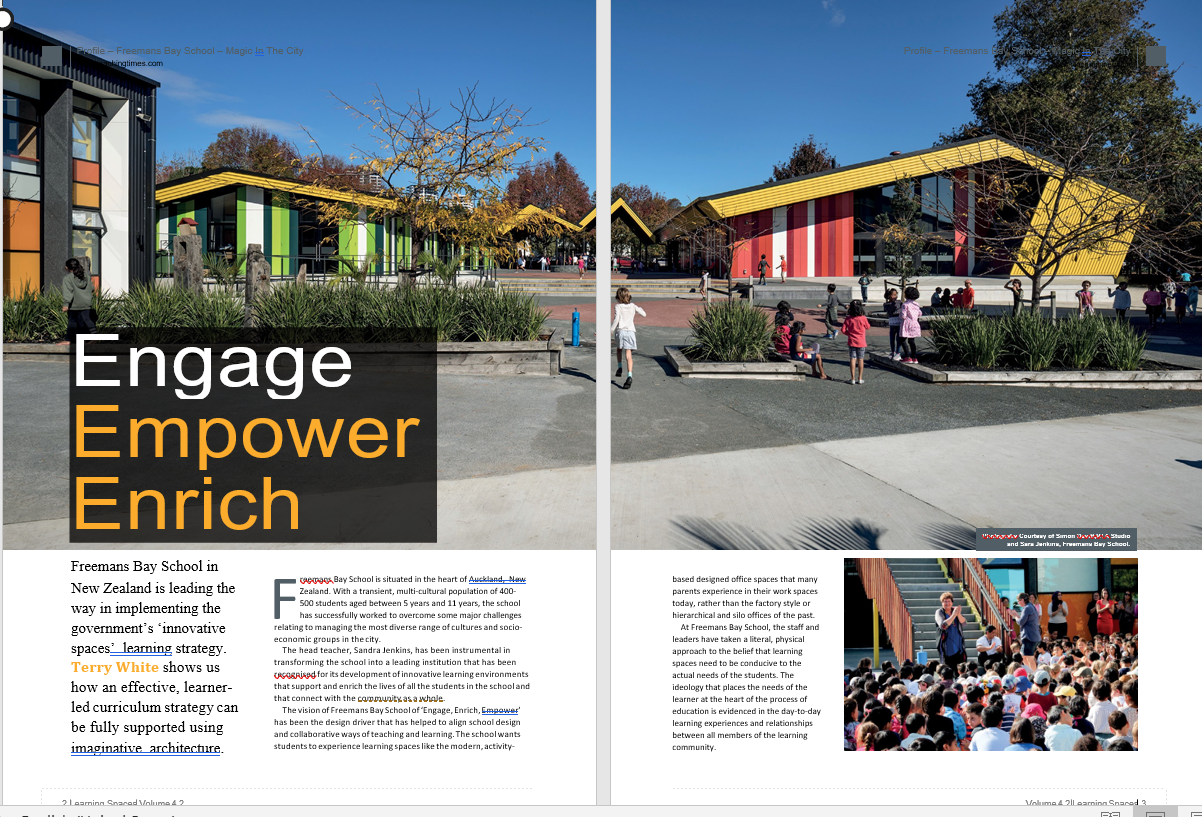
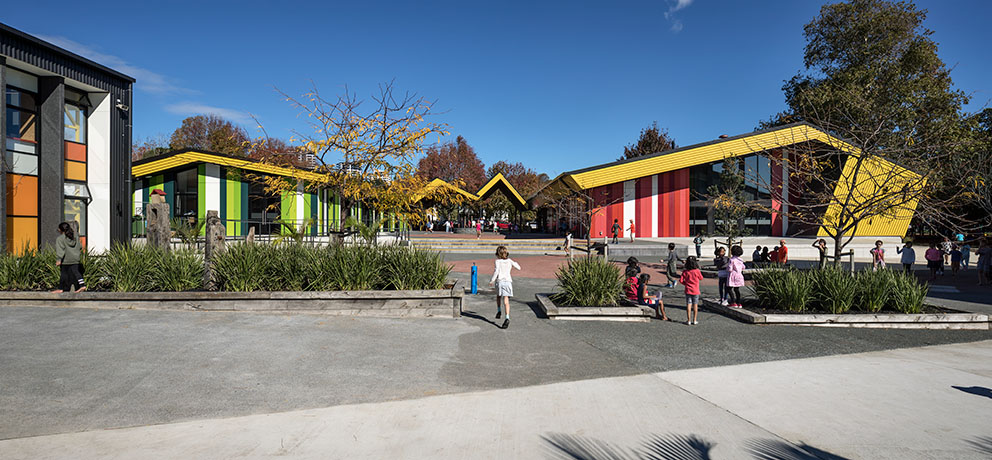
Freemans Bay School is recognised as a Microsoft Showcase School and is a Global Schools Alliance founding member. Late last year we made a video to support our application to continue being a  Microsoft Showcase School. This short video clip shows the development of our school build and how the learner led design is reflected in both pedagogy and learning spaces. Our learner led design has a lens on digital technology, ELearning and developing a future focused curriculum. 


We also had an article published in Learning Spaces magazine. This magazine is published by Association of Learning Spaces and pulls together the views of designers, educators, architects and those interested in promoting modern curriculum through spaces and pedagogy.  The magazine is well worth subscribing to. The article, also shows our thinking around the learner led design at Freemans Bay School,


Saturday, August 18, 2018

Rebuilding our School: Reflections

Freemans Bay School
Engage  Empower Enrich


Freemans Bay School is one of the oldest schools in the New Zealand. Established in 1888, it is part of the Auckland City, Western Bays network that is expected to have long term population growth.

This means that more new schools will be developed in Auckland under the Ministry of Education Flexible Learning Environments policy. (FLE).
Having been through a total new rebuild at Freemans Bay School, I have been reflecting on where we could make systems improvements on designing and transitioning into FLE environments.

Now that we are at the end of our three year rebuild project, this post is around my thinking on:

What system changes need to be explored at a national level and school level to support schools in a learner led design process that will not only see the buildings completed but also support collaborative ways of teaching and learning in the new spaces?

MOEs policy of FLEs requires a systems thinking revision at  national level.

In UK and Scandinavia the first consultant that is appointed to any new education facility is the education design consultant. This person is the lead consultant who supports schools through the process of developing and supporting the school vision both at the design stage and beyond.

We need to rethink our systems nationally to ensure that school leaders and teachers are supported to work in collaborative and flexible learning environments in a strategic way.

Having visited many new and refurbished  FLE schools in NZ and overseas, I am interested in how our MOE design policies and procedures can be strengthened to ensure that the dots a joined between the school vision for learning and the design,  incorporating evidenced best practice to inform their decisions. This process needs to be resourced at a national and school system level.

It is important for schools to consider strategically how teachers, in their teams can transition into new spaces - contextualising new ideas concerning curriculum, pedagogy and co-teaching. If the teachers theories of practice are not aligned with appropriate practice in FLE spaces they may not engage in the shifts of practice required.
   
Meeting the increasing diversity of students is recognised as being a too bigger ask for one teacher working in isolation.

Hattie’s comprehensive study of factors affecting schooling concluded that the most powerful strategy for helping students to learn, was ensuring that teacher work in teams. (Hattie, 2009)

Asking teachers to make the shift to a collaborative learning focused environment in teaching teams, on a daily basis, adds a significant layer of complexity to teaching and ways of working.

When teachers have shared ownership of groups of learners they need to be able to spend time together to plan, research, implement and adapt their practice

In our NZ primary schools teachers already have 30 hours class contact time with 1 hour a week mandated for classroom release. Time is a significant barrier to the success of collaborative learning focused relationships. This issue needs to be addressed at a national and school level.

At FBS we have recognised that staff need to be strategically supported through the change process, to be prepared to collaborate to deliver a personalised learning curriculum. 

This support is provided through a mixture of vision led workshops focused on collaboration, coaching and teacher led inquiry. We have cut down the number of after staff workshops to ensure that teachers have time to meet and to discuss their learners needs.
In 2010 Linda Darling-Hammond et al researched how high performing countries organised successful professional development for teachers. The findings were ‘extensive opportunities for ongoing professional learning embedded in substantial planning and collaboration time in school’.

Schools need to consider how they can support the daily collaboration of the teaching teams and additional PLD opportunities, based on best practice, that promote their school vision around learning in their  FLE environments.

What system changes to we need to have at a national and school level to support teaching and learning in FLE environments?


Saturday, August 12, 2017

Vision Led Design


At Freemans Bay School, we strongly believe that it is important to have a clear vision for learning that prepares students for their future. The five-year olds who start school this year will be graduating from Highschool around 2035. We need to think about what sort of spaces they will be working and studying in and join the dots between education space, curriculum design and developing attributes needed for their future world. The Innovative Learning Environment (ILE) design of our new buildings promote flexibility, collaboration, creativity, choice and personalised learning.

Our school vision of "Engage, Enrich, Empower" underpins our plan to align school design and collaborative and flexible ways of teaching and learning. We want our students to experience learning spaces like the modern activity based designed office spaces that many parents experience in their work spaces today, rather than the factory typing pool or hierarchical silo offices of the past.

The item on TV1’s ‘Seven Sharp’ show last week, looked at ILE through a very narrow lens. It was disappointing that the article was so one sided. It did not refer to the New Zealand Ministry of Educations research and evidenced based policy on ILEs accessible on their website. Nor did it refer to any of the research underpinning the global movement towards ILE in education and workplace design.  The  OECD Handbook on Innovative Learning Environments pulls together recent research on ILEs. You can also click here for some of the latest research on ILEs.

The ‘Seven Sharp’ article seems to be promoting teaching in single classrooms in the same way as  in the 1960s or back in even further. The sentiment of, “It worked for me so therefore why change things”, does not have the depth of thinking required to influence schooling design.  It is important to rethink last century school design and align with what we want to happen today. Joining the dots on the best evidenced conditions for learning and attributes required in the workforce beyond 2035 is a priority for school design.

Typical 1960's single cell classroom
Sir Ken Robinson, in his 2010 Ted talk,” Bring on the Learning Revolution”  promotes that for students to meet their creative potential in our schools we must shift from standardised schools to schools that personalise learning and create conditions where learners can discover their passions and flourish.


Saturday, October 31, 2015

Connected Educators

October was "Connected Educators" month. I was invited to collaborate to on a project to develop an e-book with a group of highly motivated people, all who have a interest in education based here in New Zealand.


 ebook


The chapter I wrote is about the amazing opportunities that I have enjoyed through connecting with others through Twitter.

Enjoy the book!

Saturday, June 27, 2015

Global Schools Alliance

I recently had an interesting email from the New Zealand High Commissioner's office in Delhi inviting me to accept and invitation for Freemans Bay School to become a member  of The Global Schools Alliance. 

This is an organisation that was established in 2014 with members from all over the world. These educationalists agree to share practice to support other progressive thinking schools in their journeys to provide education that is personalised, innovative, authentic and relevant to their learners.

The current schools involved are: 

AB Combs School, USA - rated No 1 Magnet School in the United States of America. Each child's journey is mapped for success in the real world based on the timeless principles of Steven Covey's "7 habits of highly successful people". 


Matthew Moss School, UK - ranked by Innovation Unit (UK Govt) amongst the top 10 schools (of the 21st century) in the world. Is known for its ability to align learning (through projects) with individual passions of children.


EOS Teaching Alliance, UK - Hartsholme Academy, member EOS, is rated as the most innovative primary school in the UK. Vega is a member of the EOS Teaching Alliance. 

Hilltop Road Public School, Australia - A 'learning frontiers' school that leads in embedding technology in Teaching & Learning, awarded NSW School Cohesive Awards for strong community links.

Ørestad Gymnasium, Denmark -  an award winning Scandinavian school that constantly tests new ways of organizing teaching and uses modern technology to support it. Also among the top 10 schools (of the 21st century) in the world. 

I have been spending a bit of time learning about these schools.This is an interesting clip that explains thinking from Mathew Moss School around "Slow Learning" at their school.


I can see connections with what we do at Freemans Bay School - particularly around our Passion project learning. Definitely links to personalising learning and student choice. 

It is amazing to have this opportunity to connect with The Alliance is an opportunity to connect with like-minded schools across the globe.  It will be a new journey to explore the thinking and  the journeys of these schools and their leaders. 

Sunday, November 9, 2014

Personalising learning at Skapskolan.


I was delighted to be hosted by Marcus Lighting 
at Skapskolan. http://skapaskolan.se/vad/

This is a small country school that has students from6years old to 12 years old.   Lene Jensby Lange had suggested the visit and set it up for me - and it was an inspirational visit. The ride on the 
train and buses were also very enjoyable as we left the 
country to  green fields and farmland.

Marcus and his co-teacher have mixed age group teaching in differentiated spaces for individualised and group learning. They have utilised every space available in the room - including elevated seating (mountain top) and a cave room  underneath. The room is full of options for working including quiet and collaborative spaces and making spaces. There are lots of nooks and crannies for learners to choose from.
 
The space challenge has not compromised the schools vision of personalised learning. The students are engaged and have an enthusiastic attitude to their the current learning enviroment. Plans are under way for a building extension creating and upper level. For the extension they will continue to work with architect Peter Lippman, from Australia. Lippman's design  focuses on environmental quality of lighting, air quality and temperature as well as a focus on 
student choice and flexibility in how they learn.

You could observe the older students
caring and encouraging the younger students 
both indoors and outdoors. This is due to 
the relationship building that happens with the vertical 
grouping in the classroom.

The take out for me at Skapskolan is how the creative and efficient use of  space for personalising learning is aligned school design with their beliefs around personalising learning.

In the literature review completed as part of my travel fellowship research there was consensus that personalising learning is a desire to give students more choice and control over what they were learning and where and how the learning was to take place. In terms of school design this means providing an environment where:
  •  Learning is flexible - in a range of places that could support small groups, large groups or independent activities.
  • Learning is holistic – the whole child and their learning needs supported
  • Learning styles are acknowledged and supported.
  • A range of learning opportunities provided where students are empowered 
  • Students are grouped according to learning stage not age.
  • Reflection, self-management and collaboration incorporated as part of the learning.
Personalisation refers to educational systems that prioritise the individual needs of the learner. Such systems focus on an holistic approach to meet each learners needs.  Milibrand (2004,p.8) personalised learning definition is generally accepted,  “High expectations of every child, given practical form by high quality teaching based on sound knowledge and understanding of each child needs”.     
The school visit to  Skapskolan and discussions with Marcus and later Lene gave opportunities to consider the literature review findings and observe and discuss how teaching and learning  and  school design reflected and supported the school vision around personalisation. 

I felt really inspired by my visit to this small country school. I look forward to news of the 

next iteration - I wonder how the learning from the current build will be reflected in the new build?