Hi My name is Sandra Jenkins.
Across the globe there is a movement to re imagine education to provide settings that are learner led and relevant to the future lives of learners. This blog captures some of my journey as part of that movement
Showing posts with label personalised learning. Show all posts
Showing posts with label personalised learning. Show all posts
Freemans Bay School is recognised as a Microsoft Showcase School and is a Global Schools Alliance founding member. Late last year we made a video to support our application to continue being a Microsoft Showcase School. This short video clip shows the development of our school build and how the learner led design is reflected in both pedagogy and learning spaces. Our learner led design has a lens on digital technology, ELearning and developing a future focused curriculum.
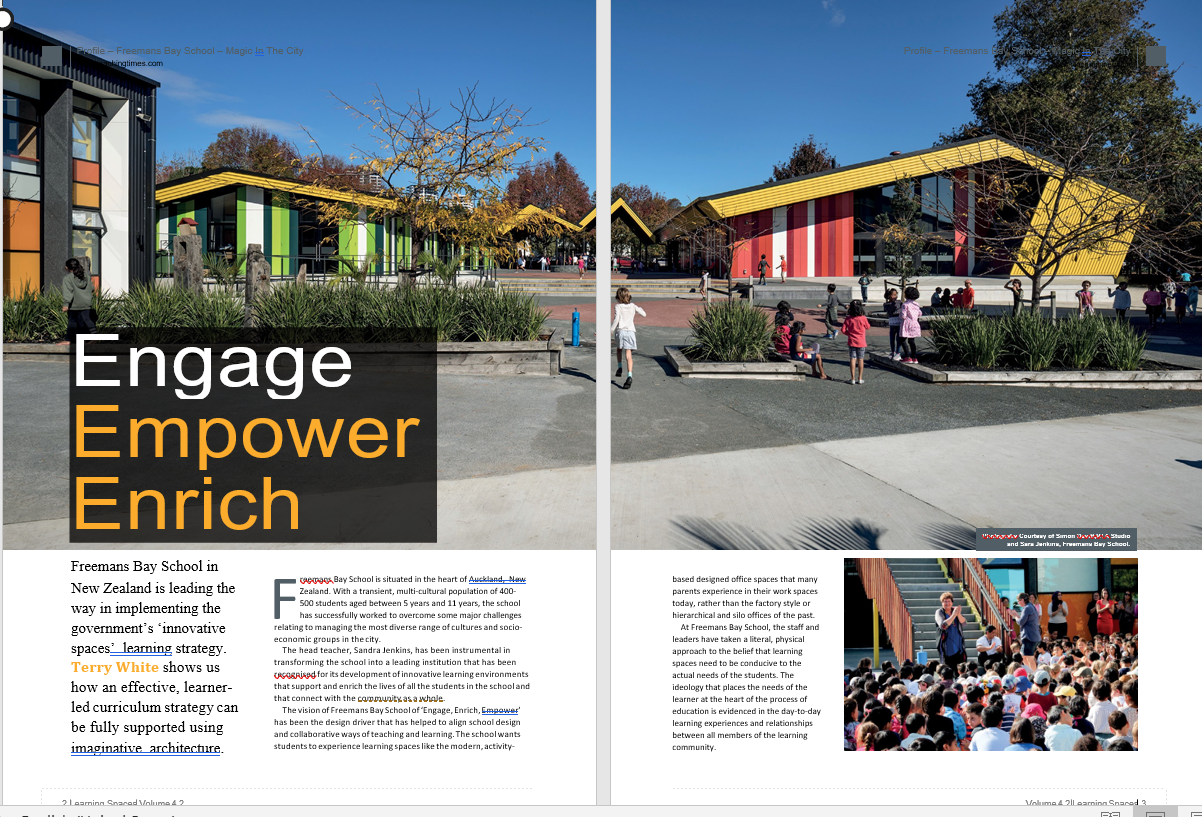
We also had an article published in Learning Spaces magazine. This magazine is published by Association of Learning Spaces and pulls together the views of designers, educators, architects and those interested in promoting modern curriculum through spaces and pedagogy. The magazine is well worth subscribing to. The article, also shows our thinking around the learner led design at Freemans Bay School,
At Freemans
Bay School, we strongly believe that it is important to have a clear vision for learning that prepares students for their future. The
five-year olds who start school this year will be graduating from Highschool
around 2035. We need to think about what sort of spaces they will be working
and studying in and join the dots between education space, curriculum design
and developing attributes needed for their future world. The Innovative Learning
Environment (ILE) design of our new buildings promote flexibility, collaboration,
creativity, choice and personalised learning.
Our school vision of "Engage, Enrich, Empower"
underpins our plan to align school design and collaborative and flexible ways
of teaching and learning. We want our students to experience learning spaces like
the modern activity based designed office spaces that many parents experience
in their work spaces today, rather than the factory typing pool or hierarchical
silo offices of the past.
The
item on TV1’s ‘Seven Sharp’ show last week, looked at ILE through a very
narrow lens. It was disappointing that the article was so one sided. It did not
refer to the New Zealand Ministry of Educations research and evidenced based
policy on ILEs accessible on their
website. Nor did it refer to any of the research underpinning the global movement
towards ILE in education and workplace design. The OECD Handbook
on Innovative Learning Environments pulls together recent research on ILEs.
You can also click here for some of the latest research on ILEs.
The ‘Seven Sharp’ article seems to be promoting teaching in
single classrooms in the same way as in
the 1960s or back in even further. The sentiment of, “It worked for me so
therefore why change things”, does not have the depth of thinking required to
influence schooling design. It is important
to rethink last century school design and align with what we want to happen
today. Joining the dots on the best evidenced conditions for learning and attributes
required in the workforce beyond 2035 is a priority for school design.
Typical 1960's single cell classroom
Sir Ken Robinson, in his 2010 Ted talk,” Bring on the Learning Revolution” promotes that for students to meet their creative potential in our schools we must shift from standardised schools to schools that personalise learning and create conditions where learners can discover their passions and flourish.
Teacherpreneurs are considered to be highly effective, connected and resourceful educators who actively seek opportunities to grow their skills, collaborate, share best practice, ideas and research. They have a passion and determination to improve education in their setting and beyond. What excites me is that teacherpreneurs can develop leadership opportunities to influence positive change to education systems for the better. With the incredible rise in technology and more demand for student agency the teacherpreneur can enable change to determine a more relevant curriculum for learners. These leaders create opportunities for educators to connect, share, grow their knowledge and expertise and influence education systems to be relevant to our students future roles in their communities. Teacherpreneurs cross oceans and cultures to make connection with other educators and advocate to transform curriculum. Their focus is to co create new learning that is relevant, authentic, personalised and technology rich, building on the diversity and strengths of all learners
October is Connected Educators month globally and in Aotearoa, New Zealand. Connected Educator Month supports educators to thrive in a connected world. Sharing and collaboration centred on personalising learning needs and strengths across our country and global networks.
Thinking about Connected Educators month has prompted me to update my reflective blog and share my own personal experience about the power of connecting on Twitter and how Twitter has facilitated amazing learning and incredible experiences for me. Through Twitter I have connectedwith teacherpreneurs and innovative educational leaders from all over the world.
In 2013 I was a new Twitter user. I only had a vague idea what it was about – but I set up an account for Freemans Bay School. I received a tweet from Lene Jensby Lange asking about our e-learning model at Freemans Bay School. Lene had checked out my principal’s blog and followed up with a couple of questions about our e-learning model
Lene is a founder of Autens Educational Design Consultancy in Denmark. This consultancy facilitates and leads innovation to support educational leaders to align their school vision with new and renovated school design. I asked Lene if I could meet her in Denmark to discuss links between learning design and school design as part of my travel fellowship in 2014. Not only did Lene agree, but she showed me around a whole lot of schools and organisations and I was able to stay with her and family in Copenhagen – where the conversations flowed into the night.
Since then we have been great twitter mates! We often have tweet or Skype, problem solving and sharing perspectives and experiences. Networking with Lene led to being invited to become a member of the Global Schools Alliance.
GLOBAL SCHOOLS ALLIANCE (GSA)
The vision of GSA was developed by a group of global educators:
David Price, OBE (member of the Most Excellent Order of the British Empire)
Andrew Raymer (Founder and former Head of Matthew Moss UK)
Dr. Steven Edwards (White House and World Bank advisor)
GSA aims to have innovative schools collaborate and be part of a learning community that will influence education systems across the world.
Lene Jensby Lange
Co-ordinator
Global Schools Alliance
Dr. Steven Edwards
Co-founder
Vega Schools
Washington D.C., USA
Sandy Hooda
Co-founder
Vega Schools
New Delhi, India
The GSA Founding members selected and evaluated progressive schools from for the Alliance. Member schools are considered highly effective and innovative in their respective countries. These schools agreed to bring their experience and knowledge to work together to improve the standards of education globally.
The vision of Global Schools' Alliance is to ensure children experience a better quality of education no matter where they live. Our mission is to collaboratively improve education that engages and empowers learners within the context of their culture and language.
The founding school leaders are from eight top-rated schools internationally.
Muriel Summers, Principal, A.B. Combs Magnet Elementary School, Raleigh, USA
Mark Moorhouse, Headteacher, Matthew Moss High School, Rochsdale, UK
Natalie See, Principal, Hilltop Road Public School, Merrylands, AUS
Allan Kjær Andersen, Principal, Ørestad Gymnasium, Copenhagen, DNK
Sugandha Mathur Anand, Head of School, Vega Schools, Gurgaon, IND
Sandra Jenkins, Principal, Freemans Bay School, Auckland, NZ
Carl Jarvis, Executive Headteacher, EOS Teaching Alliance (Hartsholme & St. Giles Academies), Nottinghamshire, UK
Barbara Cavanagh, Principal, Albany Senior High School, Albany, NZ
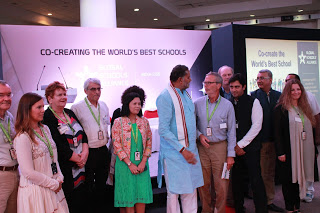
The GSA first symposium was held in October in New Delhi and was hosted by Vega School founder Sandy Hooda.
Although each school at the symposium was from a uniquely different part of the world we all shared a vision of working together to promote rich, innovative and personalised education. You can see from the following table of participants the diversity represented. It was humbling as well as inspirational to be part of this GSA symposium.
Ni Putu Tirka Widanti (Ika)
President
Yayasan Kul Kul
(Green School)
Bali, Indonesia
Green School is located in Bali jungle. It focuses on fostering green/ enviro school thinking.
Jeffrey Holte
Learning Coordinator
Liger Learning Center
Phnomh Penh, Cambodia
The Liger Learning Center, in the jungle in Cambodia, has one goal - to create change agents within their own country
Allan Kjær Andersen
Principal
Ørestad Gymnasium in Denmark
Ørestad Gymnasium (upper secondary school) has a framework for cross-disciplines and an extended use of IT-based learning by revolutionizing educational space in a structure without traditional classrooms
Melissa Daniels
Founding Director
High Tech Middle Chula Vista
USA
High Tech High is a group of schools in San Diego, USA. These schools focus on effective use of technology and digital learning.
Andy Raymer
former Head of School Matthew Moss High School
Vega Schools Board Member
Rochsdale, UK
Matthew Moss is the "most radical school in England" according to Professor David Hopkins and was featured in Innovation Unit's influential publication "10 Schools for the 21st Century". a highschool in UK Mathew Moass has a focus on child centered education through project work.
Barbara Cavanagh
Principal
Albany Senior High School
Auckland, New Zealand
Albany Senior High School has a focus on project based learning supported by coaching students to ensure the development of dispositions for learning and life
Sandra Jenkins
Principal
Freemans Bay Primary School
Auckland
New Zealand
Freemans Bay School has a curriculum design is focused on engaging, enriching and empowering learners.
Pawan Gupta
Board Member
Vega Schools
Dehradun, India
http://www.ilpnet.org/PawanGupta
Pawan Gupta is a historian, thought leader and expert on the spirit of India. Pawan has established village primary schools in the Himalayas utilising cultural and historical perspectives relevant to these school communities
During the conference we visited the Vega School construction site and will be watching the development of these schools with interest.
On the final night of the symposium we attended a large meeting where Vega Schools had invited parents, politicians and media from Delhi to hear about schools in Global Schools' Alliance. The meeting also included the state of Haryana Education Minister Ram Bilas Sharma.
The sharing of each other’s school vision was inspirational and refuelled our shared commitment to lead education that ultimately builds on learners’ strengths and diversity to equip them to contribute positively to their communities.
My twitter journey has connected me with a range of committed primary and secondary educators from all over the world. Twitter has enabled me to be meet and be involved with inspirational educators and projects across the globe.
These global leaders of education are committed to transformation of education in their countries. Student agency is the common thread of these schools’ curriculum – all engage in projects in some form or other. All are advocating to break down the homogenous systems of education, based on ranking and one size fits all models and developing systems that will strengthen diversity and learners talents in an increasingly globalised world. All are from very different cultural, social and political contexts. They have a shared mission to influence education systems to give our learners the skills and dispositions needed for their future lives.The GSA leaders have taken the concept of teacherpreneur to a new level.
I love this You Tube clip which is the work of Sandy Hooda and the team of Vega School, Delhi. – It articulates their personalised learning values and vision very
well. I am sure that a lot of people will find it very useful to promote discussion and thinking about ways to enact their schools vision for personalising learning. It also gives a bit more detail on the Global Schools Alliance. Freemans Bay School is a recent member to this alliance and as you can see the GSA has some real visionary educationists in their organisation. I am really looking forward to meeting and having some rich dialogue with them in October in Delhi at the new Vega School that is in this Your Tube clip.
Our New Zealand Ministry of Education is promoting their property
policy now called Innovative Learning
Environments. Its a useful link, also thought provoking for anyone who is embarking on school design. I like the notion that values and vision around education is becoming part of the picture painted by our policy makers. However the development of the schools learning vision and plan to transition towards the vision also needs strong leadership, resourcing and support.
The educational and political context is a little
different in NZ than the countries and schools that Sandy Hooda includes on the above Veda School video clip. We don’t have SATS like they do in UK. Schools in New Zealand are self-managing and develop
their own curriculum. Freemans Bay School has no schemes or exams. Many schools in New Zealand have
no schemes – but if they are into that and it spins their wheels – they have
them. As a school leader I always get rid of them – I have been burning school schemes since the
1980s! We also have no text books to damage learners spines as they are carried backwards and forwards to schools in backpacks.
Our secondary assessment system, NCEA, is
flexible and personalised for the learner. Our teaching and learning can be
more project based and integrated as we don’t have the pressure of national
exams from an early age. Its all about differentiation, visible learning and
personalisation. There are a lot of schools into a more project or inquiry based curriculum now in NZ. Schools such
as Albany Senior and Hobsonville Point are leading the way in this area. There
are now more secondary schools with a project based lens on their curriculum in New Zealand, than there were 10 years ago.
I think it is heartening that our Government is giving stronger leadership around school design to the education sector. Note that the learning zones do not include subject based classrooms, instead they have learning zones or hubs
where personalised learning takes place with specialist areas provided for subjects that need these spaces. Many school leaders are trying to influence the Government to resource
schools to articulate and develop their learning vision – and resource schools to develop strategic plans
to achieve this.
I think the Ministry of Education property pages on their website is a great start to assist schools with their journeys towards a more personalised and innovative curriculum – they promote lead schools with great practice to others in New Zealand and linking it to
education values, culture, collaboration and making culture.
Innovative
Learning Environments is our Ministry of Educations policy. So if you are
building a new school or remodelling – it has to be a ILE by design. The next steps would be to resource the change management needed, otherwise bookshelves will be used to
make walls and separated classroom spaces and teachers will do what they have always done and they will get what they have
always got. A Innovative Learning review tool was posted on CORE Education site recently. This is a good place to start for school leaders to review where they are at and where they are heading. However we would get greater traction to a modern national curriculum if the Ministry resourced the education vision development as part of the project.
Our students wanted a safe place to ride their bikes in the city and here they are enjoying our new facility.
They helped to design the track and now are working out how it can be used during the day. Involving students to make decisions about their learning environment really spins our wheels at Freeman Bay School.
I always remember reading in one of Fullan's leadership article "Visions That Blind" the statement, "Extend what you value". Fullan quotes Shein, (1985) observation "The process of developing collaborative work cultures is complex. It requires great sophistication for school leaders: to express their own values without being imposing; to draw out other peoples values and concerns; to manage conflict and problem solving; to give direction and to be open at the same time". I often think we feel locked into organisational systems in terms of the way that we do things, and that these ways often go back to how schools were organised in the 1960s or back in even further. We need to rethink last years organisational structures in our schools to align with what we want to happen today, to drive our vision around personalizing learning to a reality. In the article above Fullan expresses the need to have recruitment action to allow for the development of leading collaborative culture in schools. He contends that teacher professional development based on collaboratively developing the school vision is required in the short and long term. This will allow the development of a collective understanding of the learning vision of the school. The areas of focus he suggests are:
collaborative inquiry
reflective practice
growing technical expertise
restructuring
A key organisational event that ticked the boxes above that we employed was to create a new leadership position where the school leader, with prestige of salary and release from classroom teaching would lead professional learning and e-learning (blended learning) throughout the school. Effectively this school leader would map the professional learning, curriculum and ICT use in the school. This was an unusual move for a school in New Zealand of under 400 students at the time. It was pivotal to the first restructure of our infrastructure to support strengthening collaboration and personalising learning and coherence around our vision development. We decided a good place to start was to define what we want in terms of teaching and learning. What would that look like if it was in place in every learning area of our school.
This professional learning collaborative inquiry is ongoing. The model involves collaborative inquiry, reflective practice, growing technical expertise and restructuring. This professional learning model has developed a strong sense of purposeful teaching and learning practice which has led to new ways of organising teaching and learning. This has supported the process of redesigning old spaces, structures and practices that support our vision of "Engage, Enrich and Empower". This infrastructure change and inquiry based professional learning is a strong transition component for readiness to move into our new buildings in the future. It also led to other innovative organisational and physical changes that support transition and coherence of our school vision. These I will explore in the next few posts. I look forward to your thoughts.
Organizational culture and leadership: A dynamic view, by Edgar H. Schein. San Francisco, CA: Jossey-Bass, 1985,


 Andy Raymer

 Sandra Jenkins