Hi My name is Sandra Jenkins. Across the globe there is a movement to re imagine education to provide settings that are learner led and relevant to the future lives of learners. This blog captures some of my journey as part of that movement
Showing posts with label flipped learning. Show all posts
Tuesday, February 5, 2019
Learner Led Design
Freemans Bay School is recognised as a Microsoft Showcase School and is a Global Schools Alliance founding member. Late last year we made a video to support our application to continue being a Microsoft Showcase School. This short video clip shows the development of our school build and how the learner led design is reflected in both pedagogy and learning spaces. Our learner led design has a lens on digital technology, ELearning and developing a future focused curriculum.
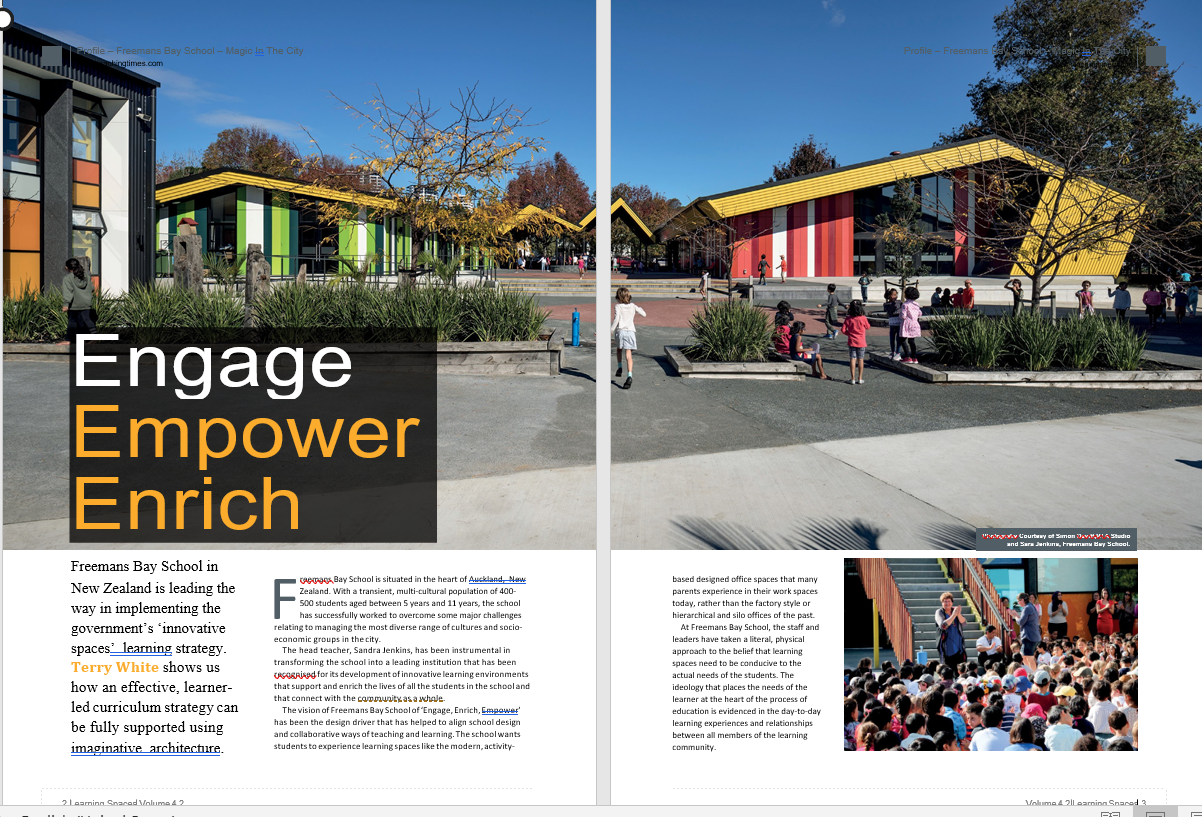
We also had an article published in Learning Spaces magazine. This magazine is published by Association of Learning Spaces and pulls together the views of designers, educators, architects and those interested in promoting modern curriculum through spaces and pedagogy. The magazine is well worth subscribing to. The article, also shows our thinking around the learner led design at Freemans Bay School,

Sunday, August 31, 2014
Visit to IPACA Academy
The first schools that Terry White took me to in UK was the Isle of Portland Aldridge Community
Academy (IPACA) opened in September 2012, bringing together five Portland
schools, the Grove, Brackenbury and Underhill, Southwell and Royal Manor Arts
College. The new primary school is a converted leisure centre. The school is
co-educational state school providing for students aged 4 – 16, together with
Foundation Stage units including nursery and reception age children.
IPACA is sponsored by educational charity The
Aldridge Foundation, which has strong links to the community forging employment
opportunities for school graduates. This thinking is considered critical as
most school leavers stay in the area – the school has a commitment to building
networks with commercial and manufacturing organisations in the district
and incorporating opportunities for students in their teaching and learning.
IPACA is led by Head teacher Alison Appleyard and its Governing Body. This body includes Sponsor Governors, Staff Governors, Local Authority Governors, Parent Governors and co-opted governors selected by the Academy Trust
Professor Stephen Heppell, is the patron of IPACA. Stephen is recognised
internationally as a leader in education. As a Heppell.net school the staff here have the advantage of working directly
with Stephen Heppell who influences the direction of the school.
Gary Spracklen is the
Director of Digital Learning and Innovation across all campus of IPACA. His
role is to drive the vision around digital learning and innovation. As an early
adaptor and enthusiast for digital and future focused learning, Gary is
exploring different ways he can work with the leadership team to make sure that
the thinking and culture around digital learning and innovation is consistent
across all five campus with ideas being explored at all levels of the
school. His blog can be explored at www.digitalipaca.blogspot.co.uk
Is an ”all through school”
focused on ”stage not age” Currently 5 years to 9 years, but new build will
take students to 18 years. The students work in house groups, across two year
groups. Each space can accommodate 90
students with 3 teachers, plus two teaching assistants. Most learning support
happens in the classroom. A typical lesson has one teacher leading 1 supporting
and 1 stretching more able students. Every learner has a chrome book from Yr 7
up.
Key educational elements of the design include:
·
spaces within spaces
·
flexibility
·
personalising learning
·
Why before the How and What
·
mixed age learning
·
digital learning
The flexible environment is achieved by a
range of different furniture including high backed sofas and utilising
furniture to make withdrawal spaces. These spaces were observed being used
flexibly in the junior areas of the school
Gary explained that in UK there is huge pressure
to teach to the SATS which schools and teachers are judged on nationally.
Personalising learning is considered to be a risk because there are tests to
pass and jobs and careers can be lost if the student achievement results take a
dive. IPACAs SAT results are impressive. Gary is working with staff across all
campus to have confidence in letting go didactic approaches and to have the
belief that the fantastic student achievement results will just get better with
the open and team teaching approach in the modern learning environment that
IPACA is committed to.
We had a brief visit to the Royal Manor
campus where the senior students are currently located and met with principal
Alison Appleyard where we discussed the proposed new campus at Southwell Park. This
exciting project is an old Navy base that is currently a commercial centre.
It will
cater for students between 3 and 16 years old, with the main school buildings
divided into houses or “schools within schools”, and a separate section for
early years children from Nursery to Year 3, with its own entrance and play
areas.
The plans
or Southwell Park include:
·
a performing arts theatre
·
heated swimming pool
·
a new sports hall
·
specialist sports, art, drama, music, science and
environmental science facilities
·
cutting-edge computer facilities and new technology
to support learning
·
a dedicated zone to support enterprise for students
and the community.
TheSouthwell Park campus would offer a range of after-school activities and
facilities will be available for after school and community programmes as part
of the commitment to linking to the local community.
My take outs from the IPACA schools include:
- · The collaborative teaching model of one teacher leading the lesson, 1 supporting and 1 stretching students, plus 1 or 2 teacher assistants for three teachers with 60 students.
- · The importance of the school structures supporting the vision of the school – eg exploring leadership and team structures in relation to the school vision around teaching and learning.
- · Teacher development around the vision and reflecting the vision/ way of working needs to be a priority. If we want staff to be developing a programme of personalised learning / learner led design – then they need to be involved in such a programme for their professional learning.
I I was impressed with the work in schools in UK where new schools were being created utilising commercial buildings - in this case both a leisure centre and naval base. This is a great way to respond to roll growth accommodation needs and get good bang for buck. The concept of several schools or campus in an Academy was new to me. I wonder how head teachers can keep in touch
with staff and learners across so many campus. The current New Zealand
Government policy direction is to create communities of schools informed I think from the academy concept. While I am
sure there are advantages the concern for me is that Government policy makers
may consider this a way to drive right wing policy around testing through a top
down hierarchy rather than developing curriculum that is future focused and
relevant to learners future lives.
Saturday, April 12, 2014
CONNECTIONS BETWEEN THINKING ABOUT LEARNING AND DESIGN OF NEW SCHOOLS
In 2010 we demolished a
large subsiding classroom block at Freemans Bay School and built new learning hubs in a two story
building. This building design was scoped to develop flexible spaces to enable
teachers to teach and students to learn in a variety of ways.
The challenge of
totally rebuilding Freemans Bay School sparked my interest in thinking deeper
about how spaces are designed and used to engage learners.
Visits to schools,
universities, libraries and co-corporate organisations in New Zealand and Australis have played a
significant role in shaping my thinking around design and pedagogy. I have had
many rich conversations with; educational, Ministry of Education, architects
and business leaders with a passion for exploring change and innovation in
their own contexts.
I am fortunate to be a recipient for the Auckland Primary Principal Association and ASB Bank Travel Fellowship for one school term in 2014. This is an opportunity to visit schools in UK and Scandinavia to explore school design.
I am interested in how the physical design can drive thinking around teaching and learning.
Specifically the following key questions are what I am looking at.
Pedagogical
· What are the beliefs
and thinking about learning evident in new schools visited across different
countries?
o the schools key
beliefs about learning
o why they believe it
and what does it look like in practice
What does teaching and learning look like in these new design classrooms?
o
role
of teachers
o
role
of students
o
role
of e-learning
How have the new
designs enabled new teaching and learning practices to emerge?
o the processes and
preparation for teachers that was required to transition to the new spaces
o the innovative
pedagogies that have emerged due to new
design
o the types of practices
that have emerged in the new spaces (e.g. collaboration, groups, team teaching,
social interactions, flexible learning, personalised learning) and how these
have changed over time
o the culture, leadership and the organisation that facilitate
(or impede) innovation pedagogies in design
o changes of job
functions of staff that have emerged to match thinking about pedagogy within the design
Physical Design
·
How are the school
beliefs about learning reflected in space design?
o ways the learning
spaces support the schools thinking about learning
o the relationships
between and significance for learning in particular spaces
o the relationships
between indoor and outdoor spaces and flows and their role in learning
o changes the school would
like to make and why
·
What impact has new
school designs had on?
o students perception
o teachers
o school community
E-learning
·
How has the new
physical design supported e-learning?
o the ways that personalised
learning through technologies is supported by the design
o the types of
e-learning practices that have emerged in the new spaces
o relationships between
virtual and built environments
·
What changes have been
made to embrace new technologies?
o how design
facilitates e-learning
o ways the learning
space has enabled evolving forms of pedagogy
I am very excited to be doing this research and will use this blog to share my findings as I go.
I am also interested in any research on the topic - so if you have any to share please let me know via the comments on the blog.
Sunday, March 16, 2014
Swedish school uses innovative design for learning
My travel to Europe and Scandinavia will enable me to explore how modern school designs reflect; the changing nature of learning, influence changes in the ways that teachers teach, engage diverse learners and meet current and future educational needs. My travel fellowship will enable me to explore recent trends in thinking about learning and design in new schools and what this looks like in practice.
I plan to be in Scandinavia in June this year where I will be looking at the relationship between school design and pedagogy.
I hope that I will be able to visit this Vittra school in Stockholm, Sweden. These students learn in a open learning environment with latest computer technology.
I am very lucky to have some great contacts to put me in contact with innovative schools in Scandinavia (Lene Jensby Lange, Autens, Denmark) and UK (Terry White, CEFPI, London)
I wonder how the learning happens in the new environments that I will view.
-How does the physical design support e-learning
-What ways is personalising learning through e-learning supported by the physical design
-What are the types of teaching and learning have emerged in the new spaces
-What are the relationships between the virtual and built environments.
I hope that my learning from the travel fellowship will influence our future building design at Freemans Bay School.
·
Sunday, June 2, 2013
Mark Treadwell presented this Prezi Learning to Learn as the opening Keynote at the CEFPI conference in Auckland last week.
Mark provoked us to stop using the term - preparing for 21 century learning - after all we are in the second decade of the 21 century so we just need to get on with it!
He discussed how learning happens! An important prerequisite for anyone involved with learning including businesses and corporate organisations, Imperative information for educationalists who need to know how the brain works and how we actually can rewire the brain to make learning happen!
Mark then linked brain / learning theory on what should happen int school building design - where students should have the opportunity to:
- Have different spaces to do different things
- Have spaces to collaborate, work in groups and work in teams
- Have quiet places to work on your own and to loose yourself
- Have spaces that can be reinvented - that are flexible
- Have spaces that meet the needs of individuals differences
- Have interesting views and outlooks
- Natural light
- Great acoustics
- Explore concepts and ideas when learning
I recently ready Noreazena Abu Samah, Noraffandy Yahaya and Mohamad Bilal Ali, paper called, "Individual Differences in Online Personalized learning Environment," which has some correlations.
They conclude:
" In order to develop a learning environment, individual differences need to be taken into consideration to ensure the impact on students' achievements and satisfactions. Therefore, the learning environment must be suitable for their differences, to include their learning styles, learning orientations, preferences and needs in learning. In addition , there is a need for instructional design to include new conditions of learning, such as; new information, context for learning and practice, feedback, transfer, organizers and attention devices. For this reason, the integration of interactivity functions in the learning environment could ensure that those external conditions of learning are provided to students."
We need to think about the types of teaching and learning practices that school design enables and the way design and teaching pedagogy can support the way the brain works and the ways we learn in both physical and digital environments.
What is your thinking about linking how the brain works and school design for learning?
Enabling Teachers to Change Pedagogy through School Design
Last week I enjoyed the Australasia Region Conference of Council of Educational Facility Planners International. (CEFPI) here in Auckland.
Stephen Harris gave a thought provoking presentation called "Factories no More: The Key Role design and furniture has in enabling Teachers to Change Pedagogy"
Stephen Harris is principal of Northern Beaches Christian School in Sydney. On the school website you can view information about the school, Stephen's blog and their professional development arm activities and related research called scil.
Stephen contends that schools that think about their vision for learning that prepares students for 2035 and beyond, that have modern open learning environments that promote flexibility, collaboration and personalised learning will disrupt old thinking and cause learning to happen that is fit for purpose.
I had a look on our Ministry of Education website examples of recent remodeled learning environments.Sadly they do look like classrooms that I experienced as a student in the 1960s.
They are currently promoting examples of single celled classrooms with adjacent cloakbays.
Stephen was exploring the notion that the design of a school, that drives where education needs to go can cause teachers to shift from old last century thinking and learning to happen at a different level.
He provoked thinking around: What are we prepared to change in order to shape a
positive, resilient learning culture? Promote what you expect to happen in teaching and learning in the design of the building.
Use design to cause learning to happen otherwise we might end up with graduates like this one - who says - " I choose C!"
What are you prepared to design into the fabric of a building for learnng? How does this link with your thinking about learning, preparing students for 2030 and why?
Subscribe to:
Posts (Atom)


