Showing posts with label how to learn. Show all posts

Tuesday, February 5, 2019

Learner Led Design

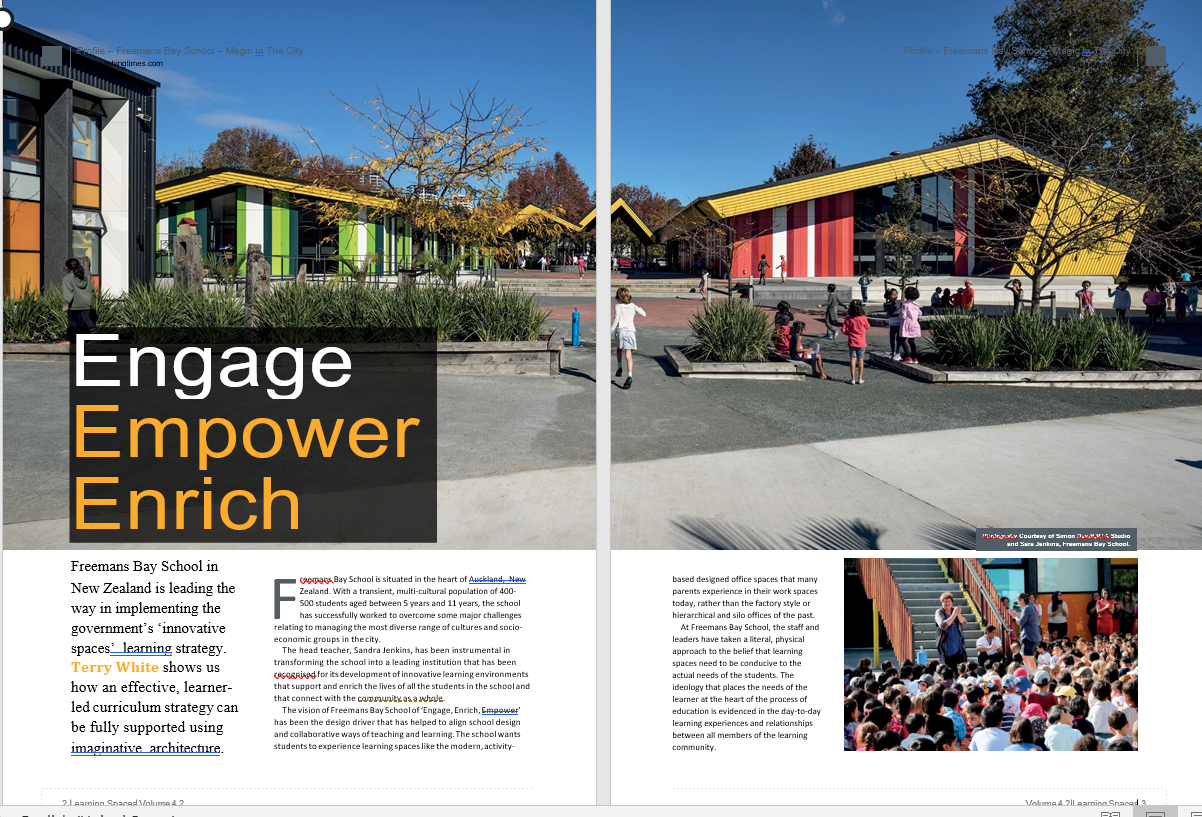
Freemans Bay School is recognised as a Microsoft Showcase School and is a Global Schools Alliance founding member. Late last year we made a video to support our application to continue being a  Microsoft Showcase SchoolThis short video clip shows the development of our school build and how the learner led design is reflected in both pedagogy and learning spaces. Our learner led design has a lens on digital technology, ELearning and developing a future focused curriculum. 


We also had an article published in Learning Spaces magazine. This magazine is published by Association of Learning Spaces and pulls together the views of designers, educators, architects and those interested in promoting modern curriculum through spaces and pedagogy.  The magazine is well worth subscribing to. The article, also shows our thinking around the learner led design at Freemans Bay School,


Saturday, February 14, 2015

A Fun Start - Exploring Possibilities


On our teacher only day to start this year - we worked with Steve Collis from Northern Beaches Christian School, SCIL Centre,  in Sydney. We worked with Steve on a one day professional development programme called; "Re-Image Learning". 

We explored video footage from Northern Beaches Christian School - we are interested in the work at this school around learning design, personalising learning and collaboration. 

SCIL Building tour - Stephen Harris from SCIL on Vimeo.

Our teachers are exploring ways to strengthen team teaching, experimenting with more open layouts and technology. We are in process of redesigning most of our school. Effectively a whole new school will replace most of our current buildings over the next two years. We have a sense of urgency around preparing our teachers and learners, in fact our whole learning community for the changes that are coming.

The modelling exercise allowed our teachers to think through what learning in our new hubs will look like and dream big. The task was to build a profile of a learner in 2017 and create a model that demonstrated a snap shot in the day, at school - a moment in time, that reflects our vision around learning. The models could be created in a range of ways (giving choice). eg virtually or cardboard, modelling clay etc. 

The teachers reflected that this was a fun, non threatening play way to integrate and develop their ideas.

This activity was a creative way to explore the possibilities of teachers working in learning hubs in a way that supports the vision of the school: Engage, Enrich, Empower. The activity put us in the shoes of the learner and reminded us the importance of having fun when learning. 

Having fun in a creative way is  an empowering way to learn - for all of us learners

Saturday, September 27, 2014

Visits in Scandinavia Schools via Lene Jensby Lange

The visits in Scandinavia were arranged by Lene Jensby Lange. Lene is founder of Autens which is an educational consultancy that works with schools, local authorities, charities, architects and others to innovate learning spaces dedicated to personalising learning. www.autens.dk   

Lene and her family hosted us in Copenhagen - we had a great time sharing philoophies about curriculum and school design.
Lene took us on a tour of schools that she has been involved with in design. The next few posts are a synopsis of the schools visited in Copenhagen and Stockholm.


Utterslev Skole is a  new school with a focus on nature and science. Their curriculum encourages  project based learning to encourage creativity, curiousity and innovation.

The school has regular classroom spaces – whole class teaching with some break out spaces.

The curriculum is subject centric – teachers are subject teachers and have their own classroom spaces with breakout spaces that can be used for independent learning.  Creative and personalised teaching based on student choice happens when the students are  with the pedagogs.

Their primary department has an integrated after school club – run by pedagogs. Pedagogs are trained to teach creatively with a holistic whole child approach.

The science facilites at Utterslev Skole were very impressive. It is an honour for students to be selected to look after the range of animals in the science laboritries.

Saturday, April 12, 2014

CONNECTIONS BETWEEN THINKING ABOUT LEARNING AND DESIGN OF NEW SCHOOLS

CONNECTIONS BETWEEN THINKING ABOUT LEARNING AND DESIGN OF NEW SCHOOLS

In 2010 we demolished a large subsiding classroom block at Freemans Bay School and built new learning hubs in a two story building. This building design was scoped to develop flexible spaces to enable teachers to teach and students to learn in a variety of ways.  

The remaining school buildings since have been identified as either leaky or past their use by date. We are now in the Ministry of Education’s new schools building project.


The challenge of totally rebuilding Freemans Bay School sparked my interest in thinking deeper about how spaces are designed and used to engage learners.

Visits to schools, universities, libraries and co-corporate organisations in New Zealand and Australis  have  played a significant role in shaping my thinking around design and pedagogy. I have had many rich conversations with; educational, Ministry of Education, architects and business leaders with a passion for exploring change and innovation in their own contexts. 

I am fortunate to be a recipient for the Auckland Primary Principal Association and ASB Bank Travel Fellowship for one school term in 2014.  This is an opportunity to visit schools in UK and Scandinavia to explore school design.

I am interested in how the physical design can drive thinking around teaching and learning.  

Specifically the following key questions are what I am looking at.

Pedagogical

·     What are the beliefs and thinking about learning evident in new schools visited across different countries?

o      the schools key beliefs about learning
o      why they believe it and what does it look like in practice

What does teaching and learning look like in these new design classrooms?

o      role of teachers
o      role of students
o      role of e-learning

How have the new designs enabled new teaching and learning practices to emerge?
o    the processes and preparation for teachers that was required to transition to the new spaces
o     the innovative pedagogies that have emerged due to  new design
o     the types of practices that have emerged in the new spaces (e.g. collaboration, groups, team teaching, social interactions, flexible learning, personalised learning) and how these have changed over time
o     the culture,  leadership and the organisation that facilitate (or impede) innovation pedagogies in design
o     changes of job functions of staff that have emerged to match thinking about pedagogy  within the design

Physical Design
·         How are the school beliefs about learning reflected in space design?
o      ways the learning spaces support the schools thinking about learning
o      the relationships between and significance for learning in particular spaces
o      the relationships between indoor and outdoor spaces and flows and their role in learning
o      changes the school would like to make and why

·         What impact has new school designs had on?
o      students perception  
o      teachers
o      school community
E-learning
·         How has the new physical design supported e-learning?
o    the ways that personalised learning through technologies is supported by the design
o    the types of e-learning practices that have emerged in the new spaces
o    relationships between virtual and built environments

·         What changes have been made to embrace new technologies?
o    how design facilitates  e-learning
o    ways the learning space has enabled evolving forms of pedagogy


 I am very excited to be doing this research and will use this blog to share my findings as I go.

I am also interested in any research on the topic - so if you have any to share please let me know via the comments on the blog.
Thursday, April 10, 2014

Professional Learning Design 2014

I often get asked what does our professional learning at Freemans Bay School look like?

I thought it would be useful to map out what we do for our professional learning and our thinking about why we do what we do.

To support our vision  to "Engage, Enrich, Empower our learners we need to have a professional learning programme that mirrors how learning happens in the classroom. The focus of our learning is based on the inquiry process, future focused learning and strengthening personalising learning for teachers. We are always tweaking what we do - but this is the current outline:

  • Cycle of Inquiry and Target Groups 
At risk students, including Maori and Pasifika students are identified each year. Teachers develop an action plan to meet the these learners needs. They are our most at risk students and as teachers, we have an obligation to do our best to accelerated their progress so they can be the best they can be.

Each whanau (teacher team)  creates a data wall with photographs eg Padlet.

At risk student progress / action plans are discussed regularly at whanau meetings.

Reflections on this work is recorded on the teacher action plans and forms part of regular team and across school discussions.

The Black Boxes of teacher and student learning frame our professional discussions as we are interested in what changes have been made in teacher practice as part of the cycle of inquiry and what difference this has made to student learning. As for things to change - teachers have to try new things to hook - especially disengaged students - into learning.


This diagram is taken from "Teacher Professional Learning and Development, Best Evidence Synthesis" Timperley, Wilson, Barrar, Fung, 2007  www.educationcounts.govt.nz/publications/series/2515/15341

  • Professional Learning Groups: 
The professional learning groups are based on future focused / blended / e-learning   to improve student engagement and learning outcomes in a pedagogy that  The PLGs are small groups of teachers from across whanau. (teams) 

This year  GAFE is being introduced to explore how these can support learning and working in our school. This work also ensures that the pedagogy is appropriate for meeting the needs of students in their ever changing world.

The teacher goals and action plans for the PLGs are recorded online on KnowledgeNET our LMS and are reviewed annually..

  •  Leadership Development
The Board of Trustees supports teachers extending their university qualifications through Post Graduate studies. This ensures that our leadership team is bringing up to date theory to practice to encourage changes in teacher practice and improved student outcomes. This includes sharing of best practice, collaboration, observations, mentoring and coaching. The leadership team teachers are released regularly for observations and coaching. They encourage their teams to participate in teacher talk to encourage best practice in teaching and learning. The focus on continuing university study is part of our philosophy of being a community of learners and ensuring that our decisions around what we do are based on the latest research around learning.

Ultimately we would like all teachers to have the opportunity to observe and have 'Teacher Talk" converstions with peers. However in a primary school context it is difficult to resource this - unless the teachers themselves can find ways to do this eg CRT time, team sharing students etc.
  • Learning Walks
Myself as principal and Deputy Principalscomplete learning walks across the school as well, usually once or twice a term.The purpose of these is to ensure teaching and learning reflects the school vision. To protect and drive the school vision. The leadership team have all completed post grad papers and other professional development around coaching/ mentoring / learning conversations. This work gives our leadership team the opportunity to grow their leadership around teaching and learning.
  • E-Learning PD workshops 
The e-learning team has regular staff workshops to support teachers tin the use of a range of technologies used in the school. These workshops are skills based and are about introducing ict skills, practising and developing new ways of personalising learning for students.

  • Teacher Reflections
All  staff to complete their on line reflections in KnowledgeNET. This includes reflecting and sharing their learning goals and action plans, reflections on their learning experiences, professional readings as well as providing evidence for RTC attestation.

Students also share their learning goals and reflections on KnowledgeNET. Both processes mirror each other. We want our teachers to be learning the same way our students are learning and visa versa.

Action Learning:
This year we have a focus on Action Learning Inquiry learning. This is driven by a desire to have our learning more personalised and intergrated. Each term teams review  their action programme and plan collaboratively the next terms action learning unit. There are workshops to review and share practice.

Kiwi Sport
As part of our commitment to kiwi sport, we have some kiwi sport skills professional development. These are a lot of fun and good for team building across the whole staff.

Mathematics:
In term three we will commence whole school Pasifika Maths. This PD is informed by  (Quality Teaching for Diverse (All) Learners in Schooling: Best Evidence Synthesis 2003).  This will challenge our thinking in terms of culturally appropriate  pedagogy and give teachers new ideas to trial with their teaching. 

Our professional learning for teachers is aligned with our beliefs about teaching and learning to give traction to our vision of "Empower, Enrich and Engage" all learners in our school.


Sunday, June 2, 2013

Mark Treadwell presented this Prezi Learning to Learn as the opening Keynote at the CEFPI conference in Auckland last week.


Mark provoked us to stop using the term - preparing for 21 century learning - after all we are in the second decade of the 21 century so we just need to get on with it!

He discussed how learning happens! An important prerequisite for anyone involved with learning including businesses and corporate organisations, Imperative information for educationalists who need to know how the brain works and how we actually can rewire the brain to make learning happen!

Mark then linked brain / learning theory on what should happen int school building design - where students should have the opportunity to:

  • Have different spaces to do different things
  • Have spaces to collaborate, work in groups and work in teams
  • Have quiet places to work on your own and to loose yourself 
  • Have spaces that can be reinvented - that are flexible
  • Have spaces that meet the needs of individuals differences
  • Have interesting views and outlooks
  • Natural light
  • Great acoustics
  • Explore concepts and ideas when learning
I recently ready Noreazena Abu Samah, Noraffandy Yahaya and Mohamad Bilal Ali,  paper called,  "Individual Differences in Online Personalized learning Environment,"  which has some correlations.

They conclude:

" In order to develop a learning environment, individual differences need to be taken into consideration to ensure the impact on students' achievements and satisfactions. Therefore, the learning environment must be suitable for their differences, to include their learning styles, learning orientations, preferences and needs in learning. In addition , there is a need for instructional design  to include new conditions of learning, such as; new information, context for learning and practice, feedback, transfer, organizers and attention devices. For this reason, the integration of interactivity functions in the learning environment could ensure that those external conditions of learning are provided to students."

We need to think about the types of teaching and learning practices that school design enables and the way design and teaching pedagogy can support the way the brain works and the ways we learn in both physical and digital environments. 

What is your thinking about linking how the brain works and school design for learning?